How New York Buyers Actually Discover and Purchase Products
New York is one of the most competitive e-commerce markets in the United States. Buyers move quickly, compare options aggressively, and expect a frictionless experience from search to checkout.




Consumer behavior varies across the region.
- A Manhattan shopper may purchase during a subway commute and complete checkout within minutes.
- A SoHo customer often searches for premium or luxury products and expects immediate trust signals.
- A Williamsburg buyer may discover products through Instagram, TikTok, or influencer content before validating options through Google.
- A Queens shopper frequently compares delivery speed, availability, and reviews before purchasing.
- A Long Island customer often prioritizes reputation, product quality, and trust before committing to a purchase.
These searches indicate strong purchase intent because shoppers already know what they want. Their remaining question is which business can deliver the best experience, the fastest fulfillment, and the highest level of trust.
Examples of the types of transactional searches commonly seen in New York include:
- same-day flower delivery Manhattan
- luxury candles SoHo
- Korean skincare Brooklyn
- gourmet coffee Williamsburg
- pet supplies Queens
- organic supplements Long Island
- birthday cakes Upper East Side
- home décor NYC
- gift baskets Manhattan
- local coffee beans Brooklyn
Shopify SEO Starts With Technical Foundations
Many Shopify stores struggle to grow because technical limitations prevent search engines from fully understanding their products, collections, and inventory relationships. Strong Shopify SEO requires more than keyword targeting.
It requires a technically sound foundation built around:
Crawlability
Search engines must be able to discover and access important product, collection, and category pages efficiently.
Indexation
Your highest-value pages should be indexed correctly while duplicate or low-value pages remain controlled.
Core Web Vitals
Page speed, responsiveness, and visual stability influence both rankings and conversion rates.
Mobile Experience
Most New York shoppers browse and purchase from mobile devices. Poor mobile usability creates immediate friction.
Internal Architecture
Improve product feed quality and shopping visibility.
Clear collection structures, product relationships, navigation paths, and category hierarchies help search engines understand your store.
Without these foundations, even strong content, backlinks, and product demand struggle to generate consistent organic revenue.
Shopify Technical Issues That Quietly Suppress Organic Growth
Many Shopify stores experience technical issues that remain invisible to store owners but highly visible to search engines.
Some of the most common issues include:
Duplicate Collection URLs
Shopify can generate multiple URLs for the same product through collection pathways, splitting ranking signals and creating indexation inefficiencies.
Product Variant Indexation Conflicts
Color, size, material, and style variations often compete with primary product pages, creating duplicate content challenges and diluted visibility.
App Script Bloat
Third-party applications frequently add unnecessary JavaScript and CSS files that slow page rendering and negatively impact mobile performance.
Faceted Navigation Crawl Waste
Filtering systems can create thousands of low-value URLs that consume crawl resources without contributing meaningful search visibility.
Orphan Product Pages
Products disconnected from collections and internal navigation often become difficult for search engines to discover and index.
Resolving these issues improves crawl efficiency, indexation quality, and overall search performance.
Core Web Vitals and Revenue Performance
Core Web Vitals are Google’s primary user experience metrics and play a critical role in both rankings and conversions.

Largest Contentful Paint (LCP)
Measures how quickly the primary content becomes visible to users.
Slow LCP scores often result from oversized images, bloated themes, app scripts, and inefficient resource loading.
Interaction to Next Paint (INP)
Measures how quickly users can interact with menus, filters, buttons, and product elements.
Poor INP scores frequently occur when multiple third-party scripts compete for browser resources.
Cumulative Layout Shift (CLS)
Measures visual stability during page loading.
Unexpected page movement caused by delayed images, banners, reviews, or promotional elements often reduces trust and increases abandonment.
Improving these metrics helps create smoother shopping experiences while supporting stronger rankings and conversion rates.
Shopify SEO New York for AI Search Visibility
Search behavior continues to evolve.
Consumers increasingly discover products through AI-powered experiences such as ChatGPT, Google AI Overviews, Gemini, Perplexity, and AI-assisted shopping experiences.
These systems rely heavily on structured data, trusted entities, and clearly organized information.To improve visibility across both traditional search engines and AI-driven search platforms, Shopify stores should implement:
- Product Schema
- Collection Schema
- Breadcrumb Schema
- Organization Schema
- Review Schema
- Accurate inventory information
- Clear category relationships
- Consistent entity signals
Rather than pursuing more informational traffic, we focused on improving purchase-intent alignment.
- Product Schema
- brand
- price
- availability
- category
- ratings and reviews
- merchant identity
- Consistent entity signals
When properly implemented, search engines and AI systems gain a clearer understanding of what you sell, who your products serve, and why your store deserves visibility.

How Entity SEO Strengthens Shopify Rankings
Modern search engines evaluate entities and relationships, not just keywords.
Your Shopify store contains multiple entity layers working together:
- Business Entity
- Brand Entity
- Product Entity
- Category Entity
- Location Entity
Entity SEO helps search engines connect these relationships through:
- schema markup
- internal linking
- collection architecture
- product categorization
- structured data
- business information consistency
The stronger these relationships become, the easier it is for search engines, Google Shopping, and AI systems to understand your products and recommend them to potential customers.
Why Google Shopping Matters for Shopify SEO
Google Shopping has become one of the most valuable discovery channels for e-commerce brands. Many purchase-ready shoppers bypass traditional search results entirely and interact directly with product listings.
Successful Google Shopping visibility depends on:
- optimized product feeds
- accurate Merchant Center data
- product schema
- pricing consistency
- availability signals
- product categorization
When these elements align, your products gain stronger visibility across Google Shopping, organic product listings, and AI-driven commerce experiences.
The RezaSEO Shopify Growth Framework
Every Shopify SEO campaign follows a structured framework designed to improve visibility, conversions, and long-term revenue growth.
Phase 1: Intent Mapping
Identify transactional keywords and high-value purchase opportunities.
Phase 2: Collection Architecture
Create scalable collection structures that support product discovery and search visibility.
Phase 3: Product Optimization
Improve product pages for rankings, user experience, and conversions.
Phase 4: Technical SEO
Resolve crawlability, indexation, page speed, and mobile usability issues.
Phase 5: Entity Validation
Strengthen relationships between products, categories, brands, locations, and business signals.
Phase 6: AI Visibility
Implement structured data and optimization strategies that improve AI retrieval and recommendation opportunities.
Phase 7: Conversion Optimization
Reduce friction throughout the buying journey and improve purchase completion rates.
What's Included in Shopify SEO New York
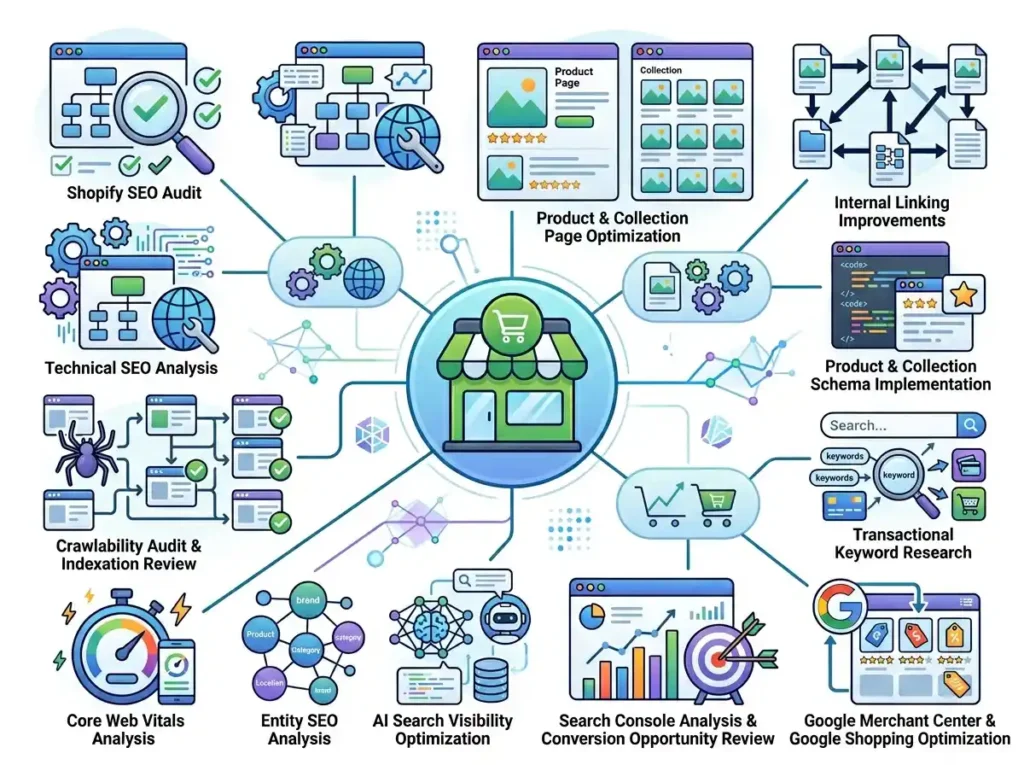
Every Shopify SEO engagement includes:
- Shopify SEO Audit
- Technical SEO Analysis
- Transactional Keyword Research
- Product Page Optimization
- Collection Page Optimization
- Internal Linking Improvements
- Core Web Vitals Analysis
- Crawlability Audit
- Indexation Review
- Product Schema Implementation
- Collection Schema Optimization
- Google Merchant Center Review
- Entity SEO Analysis
- Google Shopping Optimization
- AI Search Optimization
- Search Console Analysis
- Conversion Opportunity Review
- AI Search Visibility Optimization
Why Work With RezaSEO.com?
I help Shopify brands generate more qualified traffic, stronger visibility, and higher revenue through Shopify SEO, Technical SEO, Entity SEO, Local SEO, Google Shopping Optimization, and AI Search Optimization.
Over the past four years, I have worked with businesses focused on building sustainable growth beyond paid advertising. My experience includes analyzing and optimizing Shopify stores across industries such as home goods, beauty, skincare, supplements, lifestyle products, and other competitive e-commerce categories.
My approach combines:
- Shopify SEO
- Technical SEO
- Local SEO
- Entity SEO
- Google Shopping Optimization
- AI Search Optimization
- Conversion Optimization
The objective is simple. Build a Shopify store that search engines understand, AI systems trust, and customers choose over competitors.
⭐⭐⭐⭐⭐ Client feedback: “Our Shopify SEO Service New York finally started ranking in Maps—calls increased without increasing ad spend.”
Frequently Asked Questions
What is Shopify SEO?
Shopify SEO is the process of improving your store’s visibility in search engines so buyers can discover your products organically.
How long does Shopify SEO take?
Most stores begin seeing measurable improvements within three to six months, depending on competition, website condition, and market demand.
Is Shopify SEO different from traditional SEO?
Yes. Shopify SEO requires platform-specific optimization involving collections, product architecture, schema markup, internal linking, technical performance, and shopping-feed optimization.
What is the difference between Shopify SEO and Shopify Technical SEO?
Shopify SEO focuses on increasing visibility, traffic, and conversions. Shopify Technical SEO focuses on the underlying infrastructure, including crawlability, indexation, Core Web Vitals, schema markup, and site architecture.
Can Shopify SEO reduce ad dependency?
Many stores reduce their reliance on paid advertising after building stronger organic visibility and attracting more transactional search traffic.
Does Shopify SEO help Google Shopping?
Yes. Product data optimization, schema implementation, and Merchant Center improvements help increase Google Shopping visibility.
Can Shopify products appear in AI search results?
Yes. Structured product data, entity optimization, technical SEO, and schema markup improve the likelihood of appearing in AI-generated recommendations and search summaries.
How does Entity SEO help Shopify stores?
Entity SEO helps search engines understand the relationships between your products, brand, categories, business information, and customer signals, strengthening visibility and trust.
How does Shopify SEO improve conversions?
By aligning product pages, search intent, technical performance, trust signals, and user experience with buyer behavior.